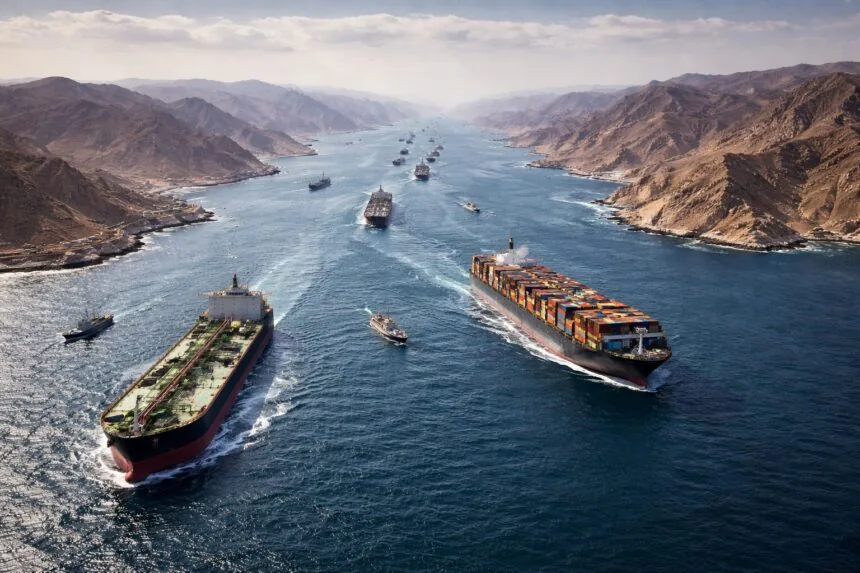
International logistics continues to operate on a premise that is often taken for granted: that critical routes will remain open, navigable and reasonably predictable. However, recent months have again demonstrated that this assumption is fragile. The evolution of the Red Sea, the uncertainty associated with the Strait of Hormuz and the responses of shipping companies, exporters and buyers confirm that maritime geopolitics remains a central variable for trade, energy and business planning.
For many companies, the impact is not measured only in days of transit. It is measured in cost overruns, route redesigns, inventory adjustments, contractual tensions, the need for additional coverage and greater uncertainty over deadlines and supply. Maritime vulnerability has shifted from a distant risk to an operational issue with direct consequences for procurement, logistics and international strategy.
The Red Sea: partial reopening, but far from full normalcy
After months marked by attacks, diversions and significant disruption to services, the Red Sea began to show signs of partial reopening at the start of 2026. Even so, normalisation is far from complete. S&P Global noted in February that several shipping companies were beginning to resume services through the Red Sea, but warned that the threat had not disappeared and that uncertainty continued to condition decisions.
Red Sea shipping reopens, but renewed threats keep route uncertainty high – S&P Global
This matters because the debate is not binary. It is not about a route being “open” versus “closed”. The real question is: what level of security, predictability and cost are companies willing to accept to resume use of a strategic route such as Suez-Red Sea?
In the short term, many decisions will continue to be taken gradually, flexibly and conditioned by insurance, reputational risk, operational protection and the evolution of the regional environment.
The Strait of Hormuz: when energy risk becomes logistical risk
Adding to this uncertainty is another geopolitical reminder: the fragility of the Strait of Hormuz. Reuters reported this month that Pakistan had asked Saudi Arabia to reroute oil supplies via the port of Yanbu on the Red Sea, following Hormuz disruption.
Pakistan seeks Saudi oil supplies via Yanbu port after Hormuz disruption – Reuters
The news illustrates an essential point well: maritime chokepoints do not only affect one country or one shipping company. They affect energy security, supply reliability and regional logistics architecture. When a critical corridor is perceived as vulnerable, the consequences extend to:
- alternative routes,
- transit times,
- fuel costs,
- insurance premiums,
- vessel availability,
- and planning capacity.
Costs, surcharges and new pressure on trade
The pressure on routes and costs is not theoretical. Reuters reported that MSC would introduce emergency fuel surcharges for various shipments from the Mediterranean and Black Sea to destinations such as the Indian subcontinent, the Red Sea and East Africa.
MSC introduces emergency fuel surcharges – Reuters
This type of decision shows how geopolitics ultimately translates into the profit and loss account. A maritime disruption can impact:
- freight costs,
- insurance,
- capacity availability,
- need for additional stock,
- and renegotiation of deadlines with customers and suppliers.
For sectors heavily dependent on production schedules or just-in-time supply, the problem is not just paying more: it is losing operational flexibility.
What is really at stake
The problem is sometimes described as simply a matter of longer routes. That falls short. What is at stake is the ability of the global trading system to continue operating with reasonable levels of predictability.
When a critical route becomes uncertain, many companies simultaneously have to rethink:
1. Inventories
Increasing stock to absorb delays has a direct financial and logistical cost.
2. Contracts
Delivery commitments, penalties and customer relationships become more sensitive.
3. Industrial planning
If supply becomes unpredictable, procurement, production and distribution are all placed under strain.
4. Supplier strategy
Dependence on certain geographies or corridors gains weight in risk analysis.
A reminder: globalisation still depends on a few chokepoints
The Red Sea, Suez and Hormuz are reminders of an uncomfortable reality: a substantial part of world trade and energy transport remains concentrated in a limited number of corridors. This turns certain maritime stretches into genuine points of geoeconomic pressure.
In a context of strategic rivalry, fragmentation of the international order and regional tensions, these vulnerabilities weigh more heavily than they did a few years ago. The efficiency of global logistics was built on the basis of relatively stable routes. When that stability erodes, not only do costs change: the logic of planning changes.
How companies should respond
Not all companies can easily redesign their routes or negotiate complex logistics contracts. But they can adjust their approach to risk.
Some sensible responses include:
- reviewing dependence on critical corridors,
- identifying suppliers excessively concentrated on a single route,
- modelling delays and cost overruns in crisis scenarios,
- strengthening visibility over transit times and insurance,
- reviewing minimum inventories of critical products,
- integrating maritime geopolitics into supply chain planning.
This does not mean overreacting. It means accepting that logistics can no longer be treated as a purely operational variable.
A strategic issue, not just a port matter
Maritime risk does not only affect transport or energy companies. It also affects any organisation that depends on long supply chains, tight delivery times or markets that require logistical predictability.
That is why the analysis of critical routes must cease to be seen as a technical matter for shipping companies and must become part of the strategic conversation of management, procurement, operations and international expansion.
In 2026, the message is clear: geopolitics is also expressed in delivery deadlines, logistical surcharges and supply contracts.